
There is a predictable way GPU conversations start.
Which one is fastest?
It is an understandable question. It is also rarely the first one we would ask.
A buyer running mature inference workloads does not have the same requirement as a team training frontier models. A cluster that needs to be operational quickly does not have the same procurement problem as an AI factory being designed around next generation infrastructure. And a workload that is constrained by memory does not necessarily benefit from solving the problem with more raw compute.
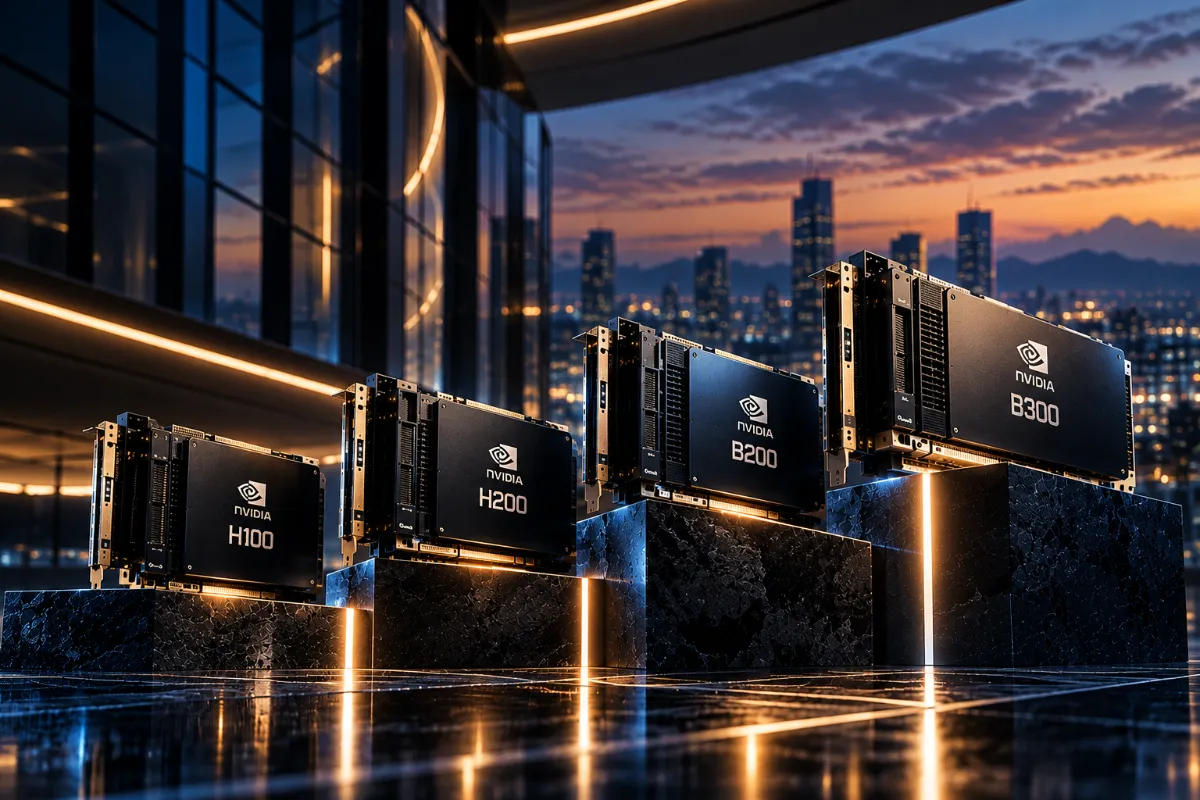
H100, H200, B200 and B300 sit on a progression of NVIDIA hardware, but that does not make the buying decision a four step ladder where the highest rung automatically wins.
The better question is simpler:
What does the workload actually need?
The short version
- H100: proven, widely deployed and still relevant when availability, existing infrastructure and economics matter more than owning the newest generation.
- H200: Hopper with substantially more memory. A logical fit when the workload is memory constrained and moving to Blackwell would introduce infrastructure changes that are not justified by the requirement.
- B200: the architectural jump. More memory, significantly more AI compute and faster GPU to GPU connectivity for buyers building around Blackwell.
- B300: Blackwell Ultra pushes further into memory intensive inference, reasoning and large scale AI workloads where concurrency, context and model size start driving the infrastructure decision.
That is the simple answer.
The useful answer needs a little more arithmetic.
H100: mature does not mean obsolete
H100 has been deployed at enormous scale, which gives it something a specification sheet cannot show: an established ecosystem.
The SXM version provides 80 GB of GPU memory, 3.35 TB/s of memory bandwidth and up to 700 W TDP. NVIDIA HGX systems commonly package eight of them together.
There are now substantially more capable GPUs.
That alone does not make H100 a bad purchase.
If the workload fits comfortably inside H100 memory, the software stack is already optimized around Hopper and suitable infrastructure is available at the right economics, replacing the requirement with a newer architecture can mean paying for capability that never becomes productive.
This is particularly relevant when time matters.
A GPU that benchmarks lower but can be contracted, delivered, installed and put to work sooner can produce more value than a theoretically superior system that spends months somewhere between allocation and commissioning.
Established training and inference workloads, existing Hopper environments, projects with defined budgets and deployments where availability matters heavily.
The question is not whether H100 is the newest option.
It is whether the workload has already outgrown it.
H200: when memory is the problem
H200 is sometimes treated as the awkward step between H100 and Blackwell.
That misses the point.
Its value becomes clearer when you look at what changed.
H200 carries 141 GB of HBM3e memory and 4.8 TB/s of memory bandwidth versus 80 GB and 3.35 TB/s on H100 SXM. NVIDIA positions it specifically around generative AI, large language models and memory intensive HPC workloads.
That extra memory changes what can stay on the GPU.
And keeping more of the model and its working data in fast memory can matter considerably more than simply adding GPUs to compensate for a memory constraint.
H200 therefore becomes interesting for buyers whose answer to “What is actually slowing the workload down?” is: Memory.
It can also offer a less disruptive progression for infrastructure already built around Hopper. NVIDIA’s HGX reference architecture supports both H100 and H200 in comparable eight GPU system designs, each using 900 GB/s GPU to GPU NVLink connectivity.
Large model inference, memory heavy HPC, larger context workloads and Hopper environments where H100 memory has become the limiting factor.
If H100 is sufficient, H200 can be unnecessary spend.
If memory is the bottleneck, it can be exactly the upgrade the workload needed.
B200: this is where the architecture changes
B200 is not H200 with another memory increase.
It moves the requirement onto Blackwell.
An eight GPU HGX B200 system carries up to 1.44 TB of GPU memory, compared with 1.128 TB for an eight GPU H200 system and 640 GB for an eight GPU H100 system. NVIDIA’s reference architecture also doubles GPU to GPU NVLink bandwidth from 900 GB/s on H100 and H200 to 1,800 GB/s on B200.
That matters when the workload stops behaving like eight independent accelerators and starts depending heavily on what happens between them.
Large training jobs, high throughput inference and increasingly complex models can make interconnect, memory and system architecture as important as the GPU itself.
But B200 introduces another question buyers sometimes discover too late:
Can the facility actually support what you are buying?
NVIDIA’s reference design allows B200 GPUs to be configured up to 1 kW per GPU. That changes the conversation around rack density, cooling, power delivery and the facility shortlist.
The GPU decision has now become a data center decision.
New AI infrastructure builds, large scale training, high throughput inference and workloads where Blackwell’s compute, memory and interconnect improvements can actually be utilized.
Buying B200 and then treating power, cooling and networking as somebody else’s problem is how a compute purchase becomes an infrastructure project halfway through the deal.
B300: when inference gets hungry
B300 belongs to Blackwell Ultra.
This is where the conversation increasingly moves beyond conventional model serving and toward reasoning, longer context, larger models and many concurrent workloads.
Blackwell Ultra provides up to 288 GB of HBM3e memory per GPU with memory bandwidth reaching 8 TB/s. NVIDIA specifically positions the platform around reasoning AI, training, post training and test time scaling.
The 288 GB number matters.
But what matters more is why it exists.
Modern inference is becoming increasingly hungry for memory. Larger models need somewhere to live. Longer context consumes capacity. KV cache grows. Concurrent users multiply the requirement again.
At some point, the question stops being How fast is this GPU? and becomes How much useful work can the system keep in flight at once?
That is where B300 starts separating itself.
It does not mean every inference deployment should move to B300.
It means workloads built around large scale reasoning, high concurrency and increasingly memory intensive models have a different economic equation from a conventional inference deployment.
Large scale reasoning inference, long context models, high concurrency environments, very large models and new AI factory deployments designed around Blackwell Ultra.
For everything else, the additional capability needs to earn its way into the requirement.
Put the four next to each other
| H100 | H200 | B200 | B300 | |
|---|---|---|---|---|
| Architecture | Hopper | Hopper | Blackwell | Blackwell Ultra |
| GPU memory | 80 GB SXM | 141 GB | Up to 192 GB | Up to 288 GB |
| Memory bandwidth | 3.35 TB/s SXM | 4.8 TB/s | Up to 8 TB/s | Up to 8 TB/s |
| Best question to ask | Do we need anything newer? | Is memory limiting us? | Are we building for Blackwell scale? | Does reasoning, context or concurrency justify Ultra? |
| Buyer profile | Proven deployment | Memory constrained Hopper | New high performance build | Advanced AI factory |
Specifications vary by form factor and system configuration. The comparison above is intended as a buying framework rather than a substitute for workload sizing.
Do not buy the GPU first
This is the part of the procurement process we think deserves more attention.
A requirement should not start: “We need 256 B300s.”
It should start closer to:
- What model are you running?
- Training or inference?
- What precision?
- How much memory does the workload require?
- What utilization do you expect?
- What latency target matters?
- How many concurrent users?
- How quickly does capacity need to be live?
- Where does it need to run?
- What power and cooling can the facility support?
- What does the network look like?
- And how long do you expect to use it?
Answer those first and the GPU requirement becomes considerably easier to defend.
Skip them and it is possible to procure an extraordinary amount of compute without solving the original problem particularly well.
The cheapest GPU and the cheapest system are not the same thing
Unit price gets disproportionate attention because it is easy to compare.
Infrastructure is harder.
A cheaper GPU requirement can need more nodes. More nodes need more networking. More racks need more space. More space needs more power. A newer GPU can cost more at acquisition while reducing the amount of infrastructure required to produce the same result.
The reverse is also true.
Buying the newest generation does not automatically create better economics if the workload cannot use what you paid for.
That is why SSP looks at the requirement as a system rather than treating the GPU SKU as the answer.
Compute, memory, networking, power, cooling, location, delivery and commercial terms eventually appear on the same bill whether they were considered together or not.
It is better to put them on the same page at the beginning.
So which one should you buy?
There is no universal winner.
H100 can still be the rational choice when the workload fits and the economics are attractive.
H200 earns its place when memory is the constraint and Hopper still makes sense.
B200 becomes compelling when the requirement genuinely benefits from Blackwell and the surrounding infrastructure is ready for it.
B300 moves the ceiling again for reasoning, context, concurrency and memory intensive AI at scale.
The expensive decision is not buying an older GPU. It is buying capability your workload does not use, or buying too little capability and rebuilding the environment sooner than expected.
Bring us the workload, not the SKU
Strategic Supply Partners sits on the buyer’s side of the requirement.
We do not start with inventory we need to move and work backwards to a reason you should buy it. We start with what the infrastructure needs to accomplish, then take that requirement to the market.
If that points to H100, we will look for H100.
If the arithmetic makes H200, B200 or B300 the better fit, we will look there instead.
And if the requirement should be structured as owned hardware, leased infrastructure or GPU as a Service, that belongs in the same conversation.
You bring the requirement. We bring the market to the table.