
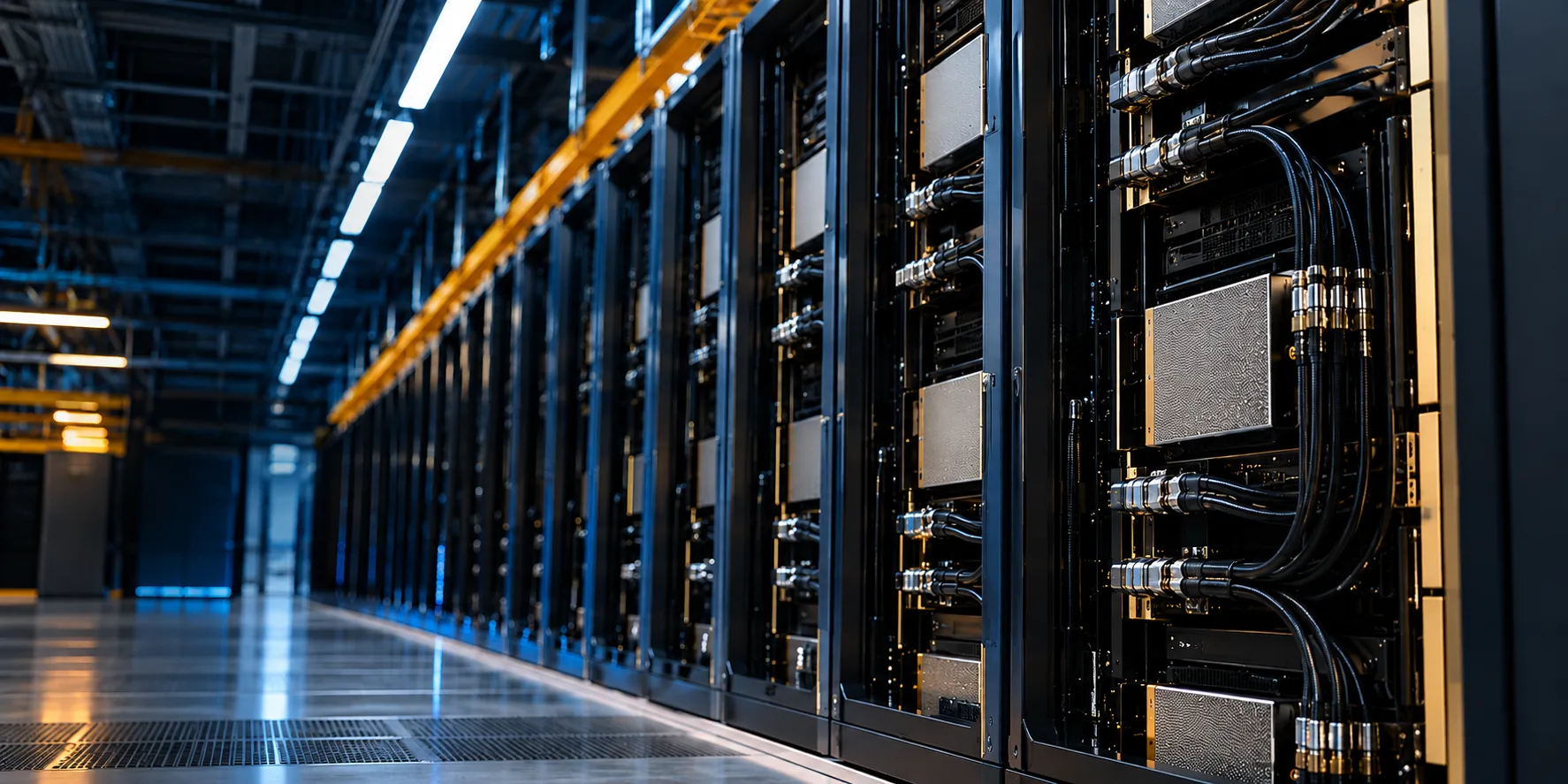
For buyers planning B300, GB300 or similar high-density deployments, that distinction matters when translating a GPU requirement into MW, rack density and facility capacity.
At Strategic Supply Partners (SSP), we work with buyers sourcing GPU capacity and the infrastructure behind it, including data center power, high-density colocation, cooling and networking. One of the first questions in a large GPU requirement is straightforward: how much power will the cluster actually need?
Start at the system level
Take the NVIDIA DGX B300. A DGX B300 contains 8 B300 GPUs, and NVIDIA specifies approximately 14.5 kW of system power consumption. NVIDIA’s data center guidance also estimates peak system power at 19 kW for the DC busbar configuration (NVIDIA DGX B300 documentation).
Scale that across a deployment and the power requirement moves quickly.
Based on approximately 14.5 kW per 8-GPU DGX B300 system. System power only.
At 512 B300 GPUs, the systems alone account for approximately 928 kW. Before networking, storage and the rest of the supporting infrastructure are considered, the compute systems themselves are already approaching 1 MW.
That is where the facility requirement becomes just as important as the GPU requirement.
1 MW available is not necessarily 1 MW deployable
When evaluating AI data center capacity, the headline MW number only tells part of the story. What matters is how much of that capacity is available as usable IT load, how it can be distributed at the rack level, what cooling architecture it supports and when it can actually be delivered.
A facility may have several MW available across a campus without having the rack density or cooling configuration required for a specific AI deployment.
PUE also matters when moving between IT load and total facility power. A 1 MW IT requirement at a PUE of 1.2, for example, corresponds to approximately 1.2 MW of total facility power.
So when a provider has 1 MW available, the next step is understanding exactly what that MW represents and how much of it is actually deployable against the requirement.
How many B300 GPUs can 1 MW support?
Using the DGX B300 as a reference point, 1 MW divided by approximately 14.5 kW per system gives a theoretical ceiling of around 68 systems, or roughly 544 B300 GPUs.
It is a useful reference point, but not a production deployment plan. Networking, storage, management infrastructure and operating headroom also need to sit within the available IT envelope.
How many GPUs can be reliably deployed within the facility’s usable power, rack density and cooling architecture? That is the number that matters when evaluating real capacity.
Rack density is where the MW becomes real
Campus capacity and rack-level capacity are two different conversations. A site may have the required MW available but still be unable to deliver the necessary density across the number of racks needed for the cluster.
For a high-density AI deployment, the important numbers include available IT MW, supported kW per rack, the number of high-density racks available, cooling architecture, redundancy and required service date. Those details tell you whether the capacity actually fits the deployment.
A megawatt available somewhere on the campus is not necessarily a megawatt ready for an AI cluster.
Power and cooling go together
At higher rack densities, electrical capacity cannot realistically be evaluated without looking at cooling at the same time. This becomes particularly important with newer rack-scale systems.
NVIDIA’s GB300 NVL72, for example, integrates 72 Blackwell Ultra GPUs into a rack-scale platform. At that density, power delivery and liquid cooling support become fundamental parts of the facility decision. A site can have the required electrical capacity and still not be suitable if its cooling infrastructure cannot support the hardware.
Future expansion matters here too. Supporting the first MW is one question. Supporting the next several MW without moving facilities or redesigning the deployment is another.
The network belongs in the calculation
The GPU systems will account for a significant portion of the load, but they are not the entire cluster. High-performance networking, switches, optics, storage and supporting infrastructure all consume power, occupy rack space and generate heat. At larger scale, those requirements become material.
This is why a calculation based only on the GPU systems should be treated as a starting point, not the final cluster power requirement.
Capacity without the right timeline does not solve the requirement
A technically suitable facility is only useful if the capacity is ready when the compute is. GPU delivery, facility RFS, power commissioning, cooling and network availability all need to align with the target deployment date.
A site offering the right capacity in Q4 2027 does not solve a Q1 2027 requirement. This is why capacity, density and RFS should be evaluated together.
The same applies when capacity is delivered in phases. If a deployment needs 2 MW initially but is expected to grow to 10 MW, understanding when the additional capacity becomes available can be just as important as securing the first 2 MW.
What to send when sourcing AI data center capacity
An AI data center capacity requirement does not need to be overcomplicated. For an active requirement, the key inputs are typically:
- GPU platform or system architecture
- Node count
- Target region
- Required service date
- Expected IT MW
- Rack density and cooling requirements
From there, the requirement can be matched against available capacity based on what the deployment actually needs. This is considerably more useful than sourcing against MW alone.
So, how much power does the cluster need?
There is no universal MW-per-GPU number. The requirement depends on the GPU platform, node count, system architecture, supporting IT, rack density, cooling and operating headroom.
The initial system power calculation gives you a baseline. From there, the requirement needs to be matched against what a facility can actually deliver.
For larger deployments, it is no longer simply how much power is available. It becomes: is the right power, density and cooling available in the right location, at the scale required, and on the right timeline?
That is the information that determines whether the cluster can actually be deployed.
Sourcing power and data center capacity for AI GPU clusters
At Strategic Supply Partners, we approach AI infrastructure as a complete requirement. Through our partner ecosystem, we work across GPU procurement and compute capacity, AI data center capacity, colocation, power, cooling, networking, logistics and deployment.
If the starting point is a GPU requirement, we can work outward to identify the infrastructure needed to support it. If the starting point is available data center capacity, we can work back from the power, density and cooling to determine what can realistically be deployed.
The objective is to align the compute and the infrastructure behind it rather than source each piece in isolation. Start at colocation and power, or size the hardware first with the power and cooling sizing guide.